

Stoning of St. Stephen
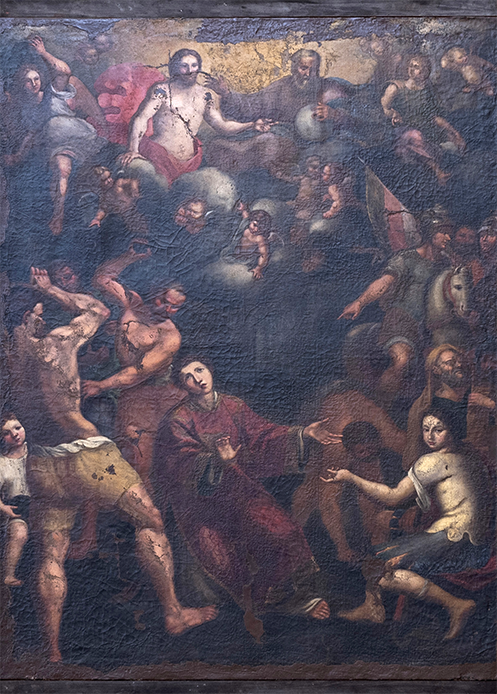
Artist: Letterio Paladino (1691 – 1743)
Date: first half of the seventeenth century.
Material: Oil on canvas
Dimensions: 200 x 140 cm
Provenance: Ancient Cathedral in the Fortified City
The painting, originally placed in the second altar of the left aisle of the ancient Cathedral of Milazzo, is now visible on the wall of the presbytery in the modern matrix. Seriously incomplete along the margins, perhaps due to damage due to the transfer of location, it has been adapted, with the addition of two wooden inserts, to a rich wooden frame carved with luxuriant leaf motifs of late seventeenth-century Baroque taste. The overcrowded scene refers to the moment when the protomartyr Stephen kneeling, with the dalmatic of a deacon and his gaze turned to the Trinity, suffers the violence of the crowd and stoning. The young man in lorica, who points to the saint looking towards the outside observer, is Saul, the future St. Paul, at whose feet, according to the Gospel account, the witnesses of martyrdom laid their cloaks (Acts of the Apostles, 7, 58).
The figure of St. Stephen, one of the seven disciples chosen for the service of the tables so that the apostles would devote more time to preaching and prayer, is linked to the institution of the diaconal ministry. Accused of having spoken blasphemous words against God and Moses, he was brought before the Sanhedrin where he delivered a long speech which, reproaching the Jews for having allowed the killing of Christ while neglecting the predictions of the prophets, aroused the ire of the elders. The cult of the protomartyr in Milazzo is of ancient date, the local tradition tells of the discovery, in 1461, of some relics preserved in the ancient church of S. Maria del Boschetto and identified twenty years later as fragments of his arm, thanks to the interpretation of some documents. In 1521, with the confirmation of the authenticity of the relics, he began to be celebrated by electing him as patron saint of the city and in 1680 the matrix of Milazzo, originally dedicated to S. Maria Assunta, was also consecrated to Santo Stefano by Archbishop Cicala.
The work, without precise documentary references, has been unanimously assigned by local sources to the Messina painter Letterio Paladino and dated to 1729. Distant from the late eighteenth-century Baroque transparencies as much as the refined novellesque naturalism, the painting openly declares its sources of sixteenth-century Tuscan-Roman matrix. Of late Mannerist structure, marked by Counter-Reformation austerity, he reworks the two versions of the subject made by Giorgio Vasari, in the seventies, for Pisa and for the Chapel of Santo Stefano in the Vatican, also keeping in mind the panel painted by Giulio Romano around 1521. The numerous figures crowd into the scene set on a single plane almost devoid of perspective depth and revolve around the fulcrum of the composition constituted by the saint who, with his eyes and the gesture of his hands, leads his gaze towards the upper part occupied by the Trinity in a choir of angels, in adherence to the rigid bipartition of the Counter-Reformation brand.
The canvas, evidently subject to numerous damages and tampering that have altered the pictorial fabric, not allowing a precise reading, shows the prevalence of brown tones, barely enlivened by the golden brightness of the divine apparition and the red of the drape that covers Christ with an articulated flourish. The author draws on the vast repertoire of forms and poses offered by the altarpieces of the Florentine painters working between the late sixteenth and early seventeenth centuries, who also played a decisive role in the Roman artistic production of these years and of whom various works arrived in Sicily. In the Milazzo canvas there are legible echoes of the painting of Filippo Paladini, Agostino Ciampelli, Domenico Cresti known as Passignano, from which derives the composure and simplification of the forms intended to correct, through greater naturalness, the formal refinements and the refined Mannerist chromatic iridescentisms, barely evoked in the lorica of the young Saul.
Drawing on these models, the artist enriches Vasari’s predecessors with the addition of various figures, such as the soldier on horseback or the child on the left who, illuminated, emerges behind the figure of the torturer, highlighting his silhouette against the light. Some ungrammatical errors in the anatomical definition of some figures, probably attributable to subsequent interventions, do not diminish the quality of the execution which, however, cannot be attributed to a precise artistic personality. The absence of stylistic evidence in the contemporary Sicilian production leads us to suppose that he was not a local artist. All formal data, however, report the execution of the painting no later than the first half of the seventeenth century; it can be reasonably assumed that it was commissioned before the consecration of the altar to the saint, also in consideration of the spread of the cult in Milazzo since the first decades of the sixteenth century.
Buda V., Lanuzza S. (eds.), Tesori di Milazzo. Arte sacra tra Seicento e Settecento, Milazzo 2015.